Concept
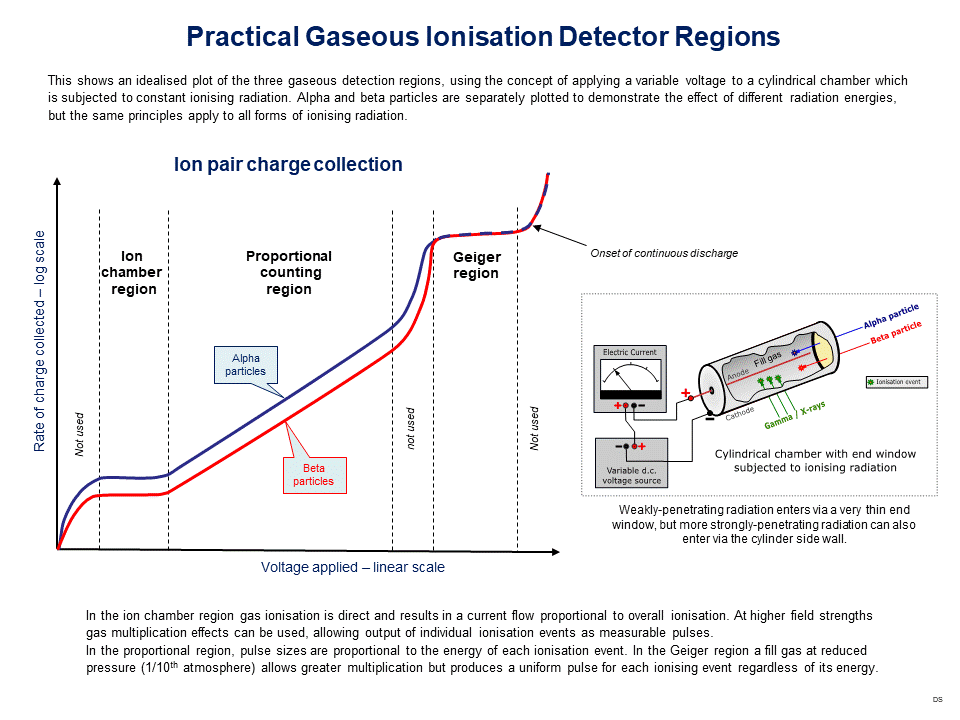
Gaseous ionization detectors are radiation detection instruments used in particle physics to detect the presence of ionizing particles, and in radiation protection applications to measure ionizing radiation. They use the ionising effect of radiation upon a gas-filled sensor. If a particle has enough energy to ionize a gas atom or molecule, the resulting electrons and ions cause a current flow which can be measured. Gaseous ionisation detectors form an important group of instruments used for radiation detection and measurement. This article gives a quick overview of the principal types, and more detailed information can be found in the articles on each instrument. The accompanying plot shows the variation of ion pair generation with varying applied voltage for constant incident radiation. There are three main practical operating regions, one of which each type utilises. The three basic types of gaseous ionization detectors are 1) ionization chambers, 2) proportional counters, and 3) Geiger–Müller tubes All of these have the same basic design of two electrodes separated by air or a special fill gas, but each uses a different method to measure the total number of ion-pairs that are collected. The strength of the electric field between the electrodes and the type and pressure of the fill gas determines the detector's response to ionizing radiation. Ionization chambers operate at a low electric field strength, selected such that no gas multiplication takes place. The ion current is generated by the creation of "ion pairs", consisting of an ion and an electron. The ions drift to the cathode while free electrons drift to the anode under the influence of the electric field. This current is independent of the applied voltage if the device is being operated in the "ion chamber region". Ion chambers are preferred for high radiation dose rates because they have no "dead time"; a phenomenon which affects the accuracy of the Geiger–Müller tube at high dose rates.
Andrea Baccarini, Imad El Haddad, Lubna Dada, Houssni Lamkaddam
Sylvain Dunand, Nicolas Würsch, Luca Massimiliano Antognini, Jonathan Emanuel Thomet, Matthew James Large
Matthias Finger, Konstantin Androsov, Qian Wang, Jan Steggemann, Anna Mascellani, Yiming Li, Varun Sharma, Xin Chen, Arvind Shah, Rakesh Chawla, Matteo Galli, Jian Wang, João Miguel das Neves Duarte, Tagir Aushev, Matthias Wolf, Yi Zhang, Tian Cheng, Yixing Chen, Werner Lustermann, Andromachi Tsirou, Alexis Kalogeropoulos, Andrea Rizzi, Ioannis Papadopoulos, Paolo Ronchese, Hua Zhang, Leonardo Cristella, Siyuan Wang, Jessica Prisciandaro, Tao Huang, David Vannerom, Michele Bianco, Sebastiana Gianì, Sun Hee Kim, Davide Di Croce, Kun Shi, Wei Shi, Abhisek Datta, Jian Zhao, Federica Legger, Gabriele Grosso, Ji Hyun Kim, Donghyun Kim, Zheng Wang, Sanjeev Kumar, Wei Li, Yong Yang, Ajay Kumar, Ashish Sharma, Georgios Anagnostou, Joao Varela, Csaba Hajdu, Muhammad Ahmad, Ekaterina Kuznetsova, Ioannis Evangelou, Matthias Weber, Muhammad Shoaib, Milos Dordevic, Meng Xiao, Sourav Sen, Xiao Wang, Kai Yi, Jing Li, Rajat Gupta, Muhammad Waqas, Hui Wang, Seungkyu Ha, Maren Tabea Meinhard, Pratyush Das, Miao Hu, Anton Petrov, Xin Sun, Valérie Scheurer, Muhammad Ansar Iqbal, Lukas Layer